
Identifying the main climate and environmental risks in Belgium to strengthen our adaptation policies.
Context
Increasingly, climate change is acknowledged as a fundamental and existential risk to our resilience and societies. To be able to take the necessary policy steps in the most efficient way possible to ensure the continued resilience of our country and society in a climate-changed future, first a good understanding of that likely future is needed.
The Belgian Climate Risk Assessment (BCRA) provides the first national integrated assessment of risks stemming from climate change and ecosystems degradation. It aims to identify the most pressing risks related to climate change and ecosystem degradation, assess their urgency and current policy readiness, and set out strategic priorities to build a resilient, fair, and secure society.

Objectives
The BCRA aims to assess the risks that Belgium faces due to climate change and ecosystems degradation and evaluates the potential impacts of these risks on key sectors and systems, while considering broader socio-economic implications.
The specific objectives of this project were:
- Analysing and prioritising risks associated with climate change and ecosystems degradation in Belgium.
- Identify knowledge gaps related to these risks and their components.
- Provide recommendations to the National Security Council and other policymakers.
- Offer guidelines for future Cerac risk assessments.
VITO was responsible for the risk analyses on infrastructure and buildings, and on human health.
Highlights
The BCRA report was drawn up on the basis of a rigorous analysis of existing scientific literature and consultation with over 250 experts. It is aligned with the methodology used for the European Climate Risk Assessment (EUCRA).
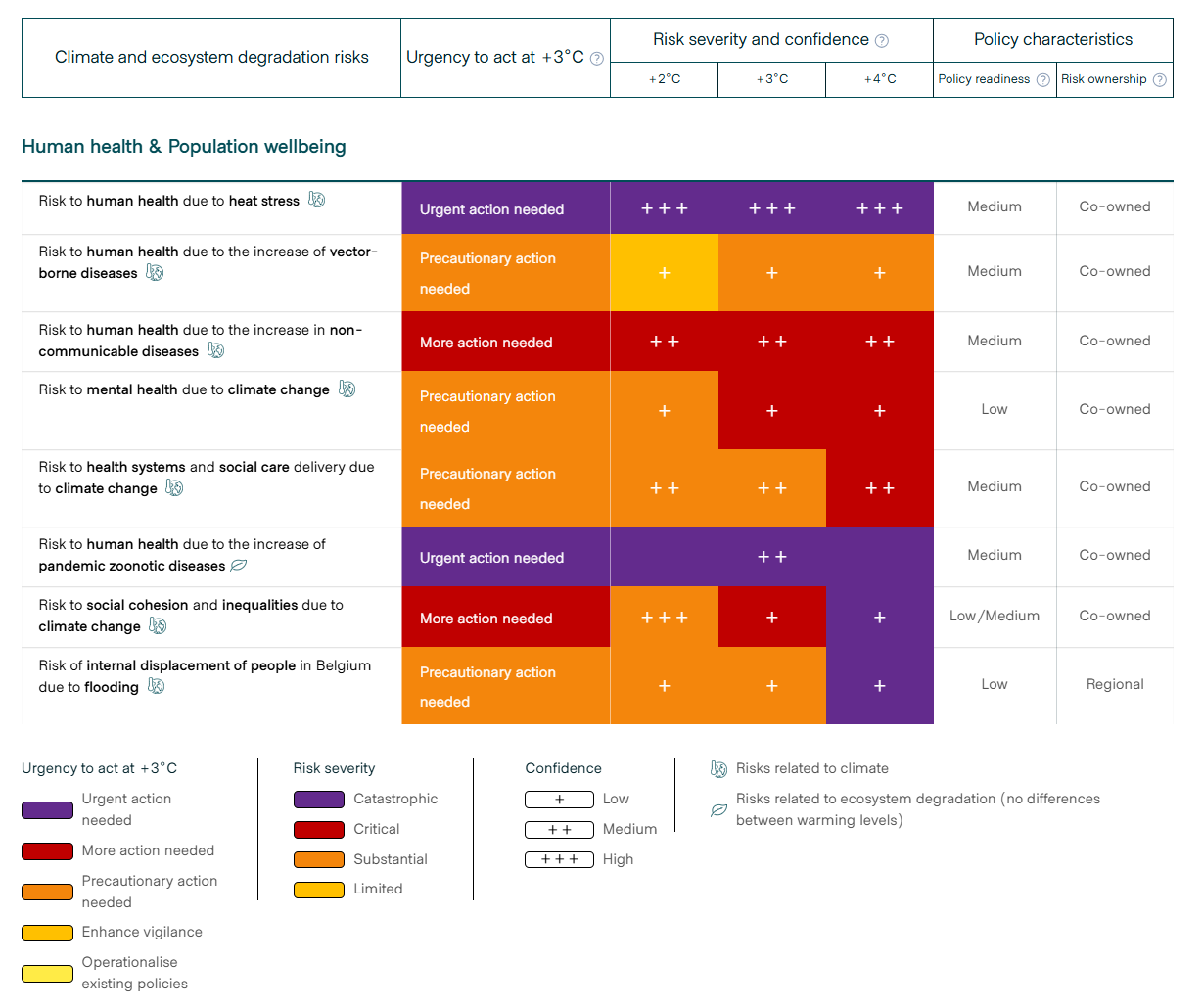
28 priority risks were identified across five clusters: ecosystems, food, infrastructure and buildings, human health and population wellbeing, and economy and finance. Each risk was assessed on the basis of its projected severity, according to multiple global warming scenarios (+2°C, +3°C and +4°C), the confidence in the assessment of the severity of the risk, and the degree of policy readiness.
Among the most urgent risks are the effects of heat on health, the impact of flooding on buildings, the emergence of zoonotic diseases, and threats to food production.
Heat stress on the human body is a priority risk. More than 1,000 additional heat-related deaths a year are expected in an optimistic climate scenario. The increase in vector-borne and zoonotic diseases, and the deterioration in air quality, are also likely to put pressure on the healthcare system.
Floods, droughts and the proliferation of invasive plants make infrastructures more fragile. The risks of subsidence, mould growth and water infiltration are multiplying, thereby compromising the durability of buildings and driving up maintenance and repair costs.

