
Climate-Health Risk Management in India
Context
Urban areas, where building structures are highly concentrated and vegetation or water is limited, become “islands” of higher temperatures relative to outlying areas. These zone are referred to as ‘urban heat islands’. This phenomenon is observed globally, also in India. This urban heating effect on top of the warming by climate change can have severe consequences. Climate change leads to more frequent and intense heat waves. Urban areas already suffering from the heat island effect will bear the brunt of these extreme heat events.
Since India is urbanising fast, this is a growing concern for authorities at national and local level. India’s urban population is expected to double by 2050 to 800 million, from 420 million in 2015. The phenomenon of urban heat island risks to threaten not only the wellbeing of the city dwellers, but also their health. Although several Indian cities have heat-action plans in place, whereby authorities suggest and prescribe the public timely measures to minimise the impact of heatwaves, such actions are short-term (i.e. typically a few days in advance). Given that climate change aggravates heatwaves and with climate change being a long term effect, adaptation measures need to be put in place now to minimise future heatwave impacts. No-regret measures, meaning, adaptation measures that remain effective even in decades to come, therefore need to consider the evolution of climatic changes towards the future. This is what CHARISMA's climate-health information service will enable.
Simultaneously, climate change is expected to have a negative impact on the prevention and control of vector-borne diseases, like Malaria, Dengue, Chikungunya, Filariasis, Japanese Encefalitis, and visceral Leishmaniasis. Therefore, in CHARISMA we combine information allowing us to map the presence of a vector and living conditions of people living in cities with information from public health authorities to model disease risk at the ward level. The ultimate objective is to develop a spatial decision support system that is ran by urban public authorities to plan vector and disease monitoring and control.

Objectives
The CHARISMA project has three main objectives:
- Facilitate and support the drawing up of strategies and no-regret action plans for climate adaptation with focus on heat- and health-related issues by giving access to quantitative information for effective risk management.
- Deliver the necessary spatial data for local urban administrations to carry out impact analysis for the development of climate adaptation plans for heat stress management and effectively combatting vector-borne diseases (spatial planning, green space management, health and emergency services, social services). To this extent an information platform was developed through co-creation with authorities.
- Raise awareness among authorities, academic institutes, and citizens regarding climate change and potential impacts.

Highlights
In co-creation with local Indian city authorities, the project partners developed an information platform containing the necessary data to design no-regret adaptation measures focused on climate-health risk management. The local partner (Centre of Environmental Health (CEH) of the Public Health Foundation of India (PHFI)) was responsible for stakeholder engagement and interaction as well as a workshop and provision of training. Belgian partners Avia-GIS and VITO covered the aspects of vector-borne diseases and heat stress respectively.
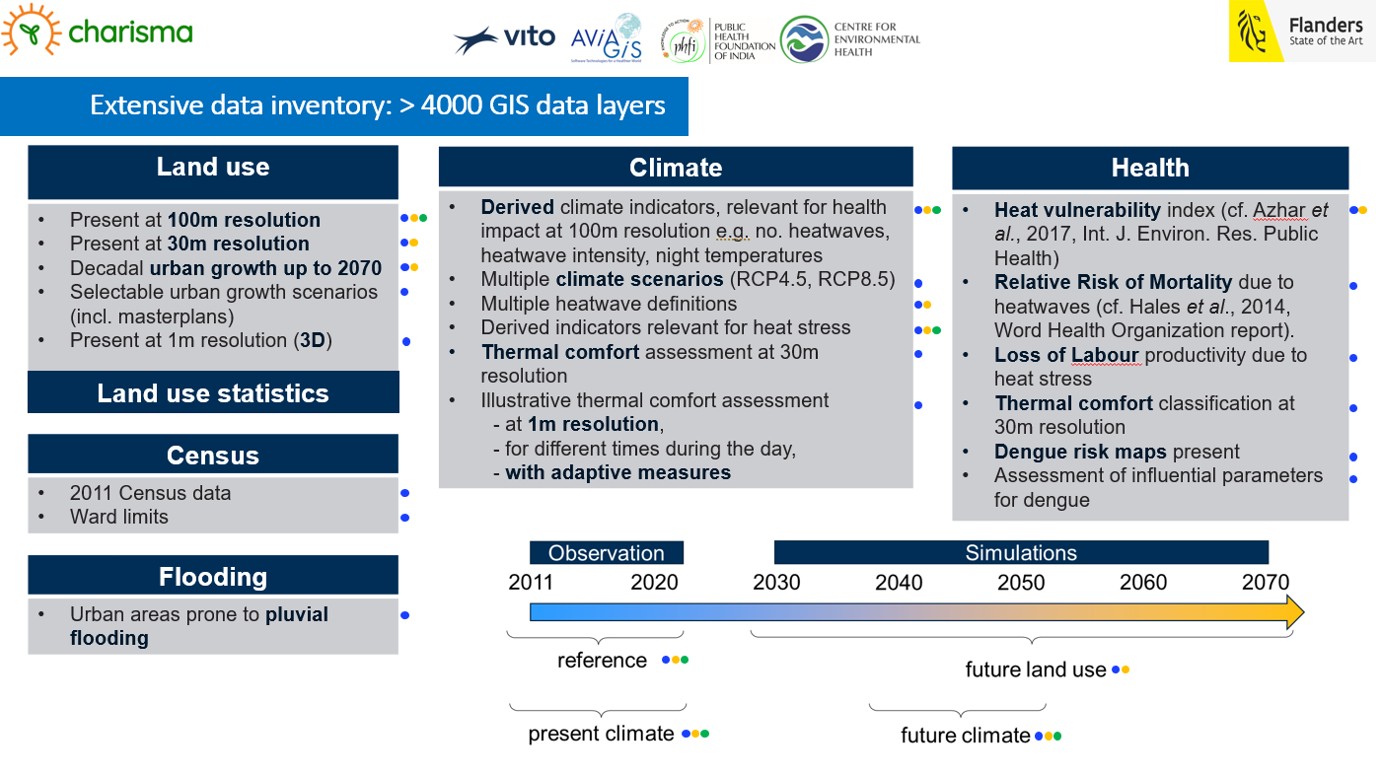
One of the outcomes is an information platform for 60 cities across India (40 of which are defined as million cities in the National Mission on Sustainable Habitat), ensuring relevance of the service. Cities are divided into tiers:
- The first tier relates to demonstration cities (Lucknow and Guwahati), for which urban growth, climate change and vector borne disease risks (Dengue) have been modelled both for the present and future. Based on the obtained data more extensive analysis have been performed leading to a first-ever Thermal Comfort Action plan for Lucknow.
- The second tier (Ahmedabad and Ayodhya) relates to cities for which urban growth and climate change have been analysed.
- Cities in the third tier have been assessed in terms of only climate change. Not only city authorities, which provided valuable local data, but also local health and meteorological experts have been consulted throughout the creation of the dashboard. Together with students of the Faculty of Architecture and Planning (AKTU) and as part of the capacity building component, areas of Lucknow were mapped in high detail to be analysed in terms of heat stress.
The platform is an interactive viewer underpinned by a database containing over 4,000 GIS data layers overall. Each demonstration city has received a tailored version, which the city of Lucknow as integrated into their Smart City Control Centre with the aid of local IT company Abhitech Private Solutions Limited. The platform is supported by an extensive manual with illustrative use cases how it can be used to design no-regret adaptation plans. This has lead to the first ever Thermal Comfort Action plan developed by local architect consultant Dharatal in consultation with VITO.
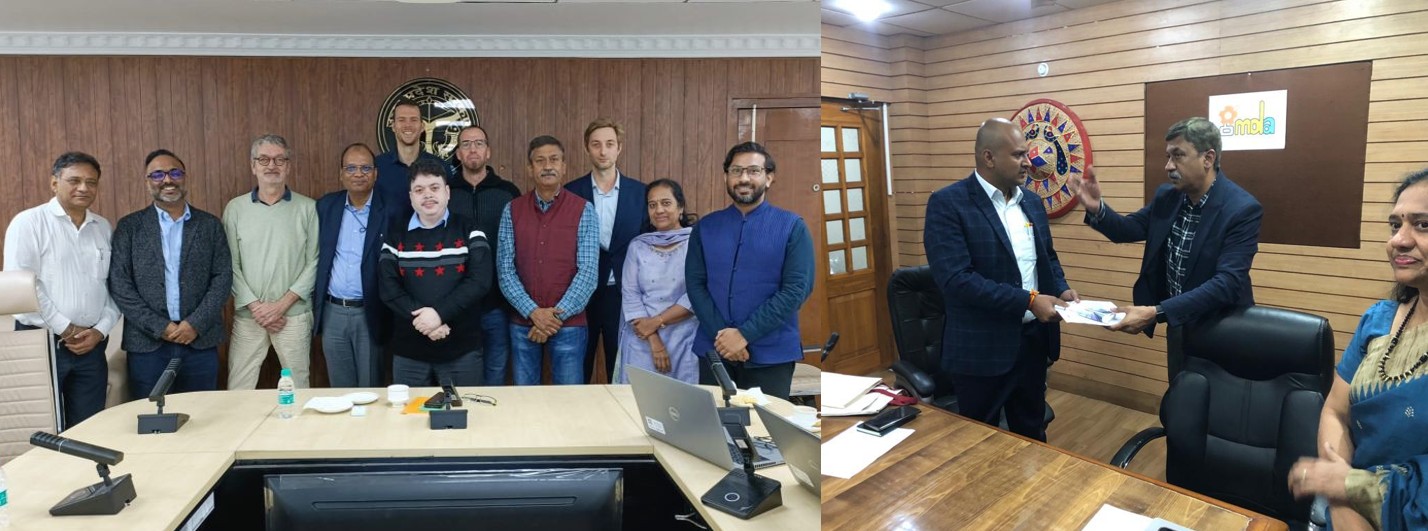
Throughout the project there was interaction with administrations at multiple levels to maximise visibility and promote uptake (National Centre for Disease Control - NCDC, National Institute of Malaria Research - NIMR, National Institute of Urban Affairs and Ministry of Housing and Urban Affairs - MoHUA). This has culminated in the hand-over of the dashboard to the Ministry of Housing and Urban Affairs, giving more than 100 smart cities access to dashboard, as well as training through a webinar organised by the MoHUA. Regional workshops have been organised in Bengalaru in collaboration with the Indian Institute for Human Settlements (IIHS); Guwahati in collaboration with the Guwahati Metropolitan Development Authority (GMDA); Ahmedabad; Patna together with the Asian Development Research Institute and finally a national workshop in Delhi attended by MoHUA, IMD, NCDC, ICMR-NIMR, Unicef, WHO, UN Environment Programme, TERI, World Bank, etc. In addition, the Faculty of Architecture and Planning, together with VITO, organised a two-day international conference on Urban Climate Resilience, attended by 28 speakers and high-level Government of Uttar Pradesh officials.
Documentation
UrbCare conference: https://urbcare.org/
CHARISMA project website: https://charisma-india.eu/en
CHARISMA video: https://youtu.be/KykUCf5daVU
CHARISMA information platform: https://charisma.marvin.vito.be/selection
Facts
Budget: € 1.101.572
Funded through International Climate Financing by the Government of Flanders
Implemented by VITO in partnership with Avia-GIS (Belgium) and PHFI-CEH (India), in consultation with Indian city authorities (Lucknow and Guwahati) and with support of AKTU-FoAP, Dharatal and Abhitech IT Services Limited